Casterbridge Union-house
Far from the Madding CrowdCasterbridge Union-house is the Poor Law institution outside Casterbridge where Fanny Robin reaches the end of her journey and dies soon after arriving. The building’s outwardly picturesque appearance stands against its function as a place of institutional care, while the brief handling of Fanny’s admission and coffin reveals the impersonal procedures governing the poor. Her death there prompts Bathsheba to claim responsibility for bringing her former family servant home to Weatherbury, and the institution becomes the setting from which the consequences of Fanny’s journey return to the farm.
Setting and Appearance
Casterbridge Union-house stands outside the town, reached by a deserted avenue of chestnuts. Ivy covers its walls so completely that the building resembles an abbey, and its position affords a striking view over Casterbridge’s chimneys. The inmates, the narration observes, might have preferred the income of the neighbouring earl to the view from their residence: the landscape’s beauty does little to alter the institution’s purpose or the residents’ circumstances.
The building is described as a stone structure with a central section and two wings. Its ivy-clad exterior softens the appearance of the place, but the description makes clear that this is a shelter for people in need rather than a religious house. At the side, a high gable has no window, chimney, or ornament; its only notable feature is a small door set several feet above ground. Ruts beneath the raised sill reveal that the door is used to transfer people and goods between the building and a vehicle. Grass growing in the sill’s cracks suggests that this entrance is used only occasionally.
Fanny Robin’s Arrival
Fanny reaches the Union-house after walking toward Casterbridge while gravely exhausted. At night she rests beneath a haystack, then continues toward the town. She later accepts the help of a stray dog, leaning on its shoulders as she moves; when she can no longer keep going, the dog tries to draw her forward, and she calls it back. Avoiding notice from other people, she and the animal skirt the town and arrive at the building near six in the morning.
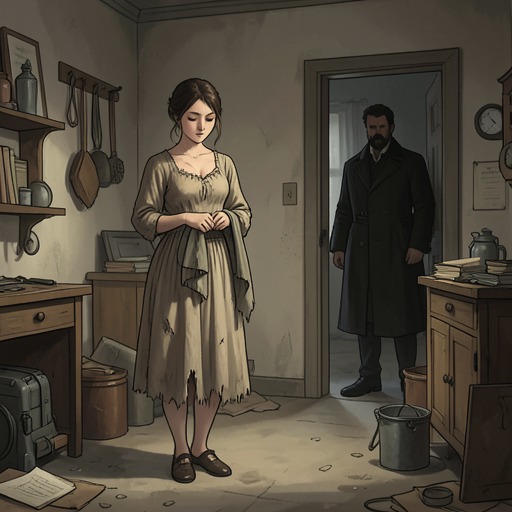
Too weak to stand at the entrance, Fanny raises herself onto her knees and reaches for the bell-pull. A man comes to the small door, finds her collapsed outside, and returns with two women, who help carry her in. Before they take her away, Fanny asks where the dog has gone and explains that it helped her. The man says he drove it off. This brief exchange marks the end of the companionship that had sustained her on the last part of her journey: the dog remains outside as Fanny is taken into the institution.
Care, Death, and Removal
Fanny dies at the Union-house on the day she arrives. Joseph Poorgrass later tells Bathsheba that she became ill in the morning and died in the evening, after being brought in weak and worn out. He understands that Fanny belongs by law to the parish and reports that Boldwood has arranged for a wagon to bring her back for burial. The narrative gives no extended account of her treatment inside the institution; its emphasis instead falls on her arrival and on the official process that follows her death.
That process is visible at the building’s raised side door. At a few minutes before three, Joseph brings a blue spring wagon picked out in red, decorated with branches and flowers. After he rings, he is told to back the wagon up to the high door. Two men push out a plain elm coffin and place it in the vehicle. One writes Fanny’s name and a few other words on the coffin in chalk, covers it with a worn but decent black cloth, and hands Joseph a registration certificate. The men then return inside, and their brief connection with Fanny is over. The scene makes official procedure concrete: a name on the coffin, a certificate for the driver, and a transfer completed at a door used for conveying people and goods.
Return to Weatherbury and Significance
When Bathsheba hears that Fanny has died in the Union-house, she refuses to leave the arrangements to Boldwood. Although Fanny had served her uncle and Bathsheba herself knew her for only a short time, Bathsheba says that Fanny belongs to her and takes responsibility for bringing her back. She initially considers a hearse, then decides on the clean blue wagon with red wheels, instructs Joseph to cover the coffin with evergreens and flowers, and asks that the horse Pleasant draw it because Fanny knew him. The Union-house is thus not only the place where Fanny dies; it is the point from which Bathsheba’s act of recognition and care begins.
Joseph’s account that Fanny had recently been working as a seamstress in Melchester, and may have walked from there, unsettles Bathsheba. She asks whether Fanny passed along the turnpike road and when she passed Weatherbury; on hearing that it was the previous Saturday night, she becomes pale and faint. Her questions connect the woman who arrived at the institution to a journey Bathsheba had not known about. In this way, the Union-house’s brief record of Fanny’s arrival and death carries consequences beyond its walls, redirecting attention to the events and relationships that preceded her final journey.
The contrast between the building’s picturesque ivy and the practical side door sharpens the location’s significance. From the front, it can look like an abbey set above a notable view; at the gable, its raised opening is plainly designed for institutional transfers. Fanny’s passage through that doorway, followed by the removal of her coffin through the same entrance, brings the building’s aesthetic surface into contact with the procedures that govern the poor. The Union-house’s role in the novel is therefore both material and narrative: it receives Fanny when she can go no farther, and it sends her story back to Weatherbury in a form that her former household can no longer ignore.